We are creating a store. Note that this is a demo store for testing purposes — no orders shall be fulfilled.
Fermented Foods and Probiotics: What's the Real Difference?
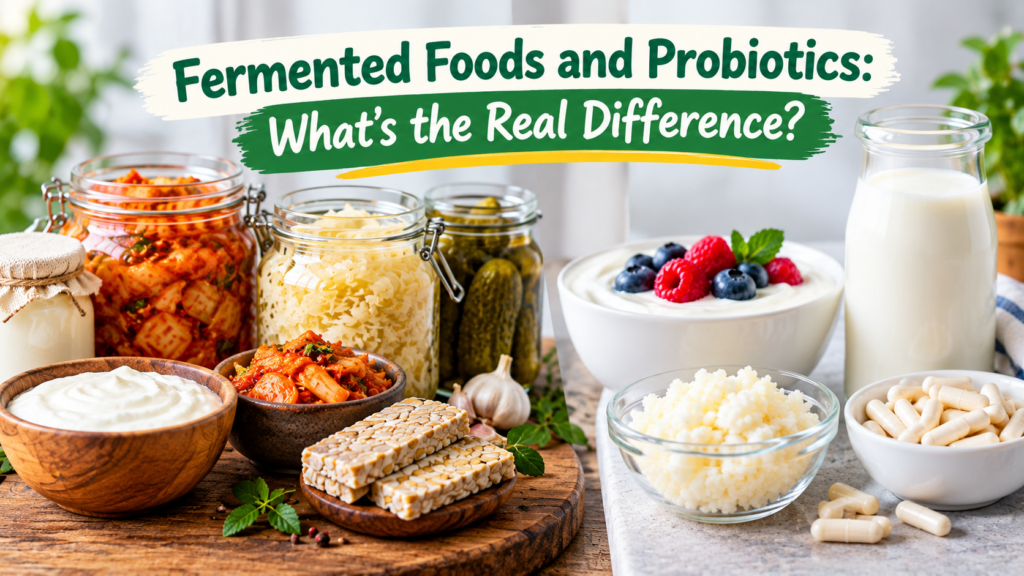
Fermented foods and probiotics are often used interchangeably, but they are not the same thing. One is a category of food; the other is a group of live microorganisms that must meet specific scientific criteria to earn the name. Understanding the distinction matters — especially if you’re choosing what to eat or buy to support your gut.
Table of Contents
ToggleThis guide breaks down the real difference, explains why kefir stands out among fermented foods, and shows how a prebiotic like wheatgrass fits into the picture.
What Are Fermented Foods?
Fermented foods are made through controlled microbial growth, where bacteria and yeasts convert sugars and starches into acids, gases, and alcohol. This process preserves food, enhances flavour, and can introduce beneficial compounds.
Common examples include:
-
Dairy ferments — kefir, yogurt, mursik, kule naoto
-
Cereal ferments — uji, sourdough
-
Vegetable ferments — sauerkraut, kimchi
-
Beverage ferments — kombucha, water kefir
Not every fermented food contains live microbes at the point of consumption. Pasteurisation, baking, and filtration can kill or remove them. Sourdough bread and most soy sauce, for example, are fermented but no longer contain live cultures.
The key point: “Fermented food” describes how a food is made — not whether it delivers live probiotics.
Among fermented dairy options, kefir stands out as a fermented food that reliably delivers live cultures — it is made with live kefir grain cultures that remain active when properly stored. We’ll explore exactly how kefir works as a fermented food and probiotic in its own section below. For a deeper look at kefir’s full range of benefits, see our complete guide to kefir benefits.
What Are Probiotics?
The International Scientific Association for Probiotics and Prebiotics (ISAPP) defines probiotics as live microorganisms that, when administered in adequate amounts, confer a health benefit on the host. This definition is widely accepted in the scientific community.
Crucially, not every live microbe qualifies as a probiotic. To meet the definition, a strain must:
Be alive when consumed
Be present in adequate numbers
Have documented health benefits in controlled studies
Understanding the relationship between probiotics and fermented foods is key to choosing the right gut health support. A fermented food may contain live bacteria, but unless those specific strains have been studied and shown to deliver health benefits at the dose provided, it is not technically a probiotic.
Fermented Foods vs Probiotics: The Key Differences
The core difference is simple: a fermented food is defined by how it is made, while a probiotic is defined by what it does. A food can be fermented without containing live probiotics, and a probiotic can be delivered as a supplement rather than a food.
Here is why the distinction matters:
Live cultures are not guaranteed in fermented foods. Pasteurisation, baking, and filtration can kill or remove the microbes—so a fermented food may contain no live cultures by the time you eat it. Probiotics, by definition, must be alive when consumed.
Strain specificity differs. Fermented foods rarely specify which microbial strains they contain. Probiotics must list specific strains (genus, species, and strain designation) because their health benefits are strain-dependent.
Regulation is different. Fermented foods are regulated as food. Probiotics are often regulated as supplements, which means quality and label accuracy can vary more widely.
The evidence base is not the same. Fermented food research is growing but variable by food type. Probiotic evidence is strain-specific and requires clinical studies for each claimed benefit.
Reliability depends on different things. For fermented foods, it depends on freshness and proper storage. For probiotics, it depends on product quality—and studies show that many commercial probiotic products fail to meet their label claims.
Summary Comparision
Feature | Fermented Foods | Probiotics |
How it is defined | By the fermentation process | By documented health benefit |
Live cultures guaranteed at consumption? | Not always — depends on processing | Yes, by definition |
Strain specificity | Often undefined or variable | Specific strains, often listed on labels |
How it is regulated | As food | Often as supplements (varies by country) |
Evidence required | Growing, but variable by food | Strain-specific clinical studies |
Reliability | Depends on freshness and storage | Depends on product quality |
The reliability gap is real. A study of commercial probiotic products found that only 2 out of 25 products had both acceptable labelling and viable bacterial growth that met label claims [PDF]. Another analysis found that none of the 10 products tested matched their labelled microbiological specifications.
Fermented foods are not immune to quality issues either — but they have an advantage: you can often tell if a fermented food is alive by its taste, smell, and texture. A probiotic capsule gives you no such signal.
Why Kefir Stands Out Among Fermented Foods
Kefir stands out because it is the rare fermented food that reliably delivers live probiotics while containing dozens of microbial species. Most fermented foods are defined by how they are made. Kefir is defined by both its process and its living microbial community.
How Kefir works:
It is made with kefir grains — complex symbiotic communities of bacteria and yeasts, not a simple starter culture
It contains greater microbial diversity than most fermented dairy — research published in PubMed Central on yeast and kefir composition in kefir has identified more than 50 microbial species in different milk kefirs
It delivers live cultures when properly stored — the bacteria and yeasts remain active at consumption
What does the science on kefir say?:
A clinical trial on kefir effects on fecal microbiota and IBD symptoms gave kefir to patients with inflammatory bowel disease — a group of conditions that includes ulcerative colitis and Crohn’s disease. After drinking kefir, patients had more Lactobacillus (a beneficial gut bacteria) in their systems, and lower levels of inflammation and bloating.
The researchers concluded that kefir’s dominant bacteria include Lactobacillus species with probiotic properties — meaning the microbes in kefir are the kind that can actually benefit human health.
Kefir’s advantages over other fermented foods:
Greater microbial diversity — kefir grains contain bacteria and yeasts in stable symbiotic relationships
Live cultures at consumption — when properly made and stored, kefir delivers active probiotics
Documented effects on gut microbiota — including increases in beneficial Lactobacillus populations
For a closer look at how kefir supports gut health and immunity, explore our detailed kefir benefits guide.
When Probiotic Supplements Make Sense
Probiotic supplements have legitimate uses — particularly for specific, strain-dependent health outcomes. Certain strains have been studied for antibiotic-associated diarrhoea, IBS symptom relief, and immune support.
But supplements have a reliability problem. The quality studies cited earlier show that label claims often don’t match contents. If you choose a supplement, look for:
- Specific strain names (genus, species, and strain designation)
- CFU (Colony-Forming Units – refer to the number of live, viable probiotic bacteria actually present when you take the product) counts at the time of consumption, not just at manufacture
- Third-party testing or certification
- Reputable brands with transparent sourcing
How Prebiotics Fit In on matters gut health — and Why Wheatgrass Matters
Probiotics need fuel to work. That fuel is called a prebiotic, and wheatgrass is a natural source of it.
A prebiotic is a non-digestible food component that selectively feeds beneficial gut bacteria. In simple terms: probiotics are the bacteria, and prebiotics are their food.
How wheatgrass supports the gut:
-
It contains inulin and complex fibers — these are prebiotic carbohydrates that feed beneficial bacteria
-
It promotes microbial diversity — the fermentation of these fibers supports a healthier balance of gut bacteria
-
It produces short-chain fatty acids — these compounds help maintain the intestinal lining and support gut health
Wheatgrass is not a probiotic itself — it contains no live bacteria. But it plays a complementary role: preparing the gut environment so the probiotics from kefir can establish more effectively.
If kefir is your probiotic source, wheatgrass can be your prebiotic support. To explore wheatgrass’s full role in gut health and beyond, see our detailed guide to wheatgrass benefits
How to Combine Fermented Foods and Probiotics for Gut Health
- Make kefir your daily probiotic base — a small glass delivers live cultures and microbial diversity
- Add a prebiotic source — wheatgrass powder or juice feeds the bacteria kefir introduces
- Rotate traditional ferments — uji, mursik, and kule naoto add variety and cultural value
- Be consistent — small daily portions matter more than occasional large servings
- Choose quality — fresh, properly stored fermented foods are more reliable than most supplements
Where to Buy Kefir Fermented Milk in Kenya
- Kefir whole cultured milk — made with live kefir grain cultures for authentic probiotic diversity
- Unflavoured kefir yoghurt — pure cultured milk without added sugars
- Fresh on order — Kefir is processed to order, never stored in advance
- KEBS certified — Tested for purity and safety
- Grown and processed locally — A Kenyan brand, produced on our Kikuyu farm
- Nationwide delivery — We serve Nairobi, Mombasa, Kisumu, and across Kenya
- Phone: 0725404661
- WhatsApp: 0140789905, 0792949418
- Email: contact@springshealthcare.org
- Location: Kenya, Kiambu County, Kikuyu Constituency
Frequently Asked Question on Fermented foods and Probiotics
Is It Better to Eat Fermented Food or Take a Probiotic?
For everyday gut support, fermented foods like kefir are generally the better choice because they deliver live microbes alongside prebiotic fibers and nutrients. Probiotic supplements are useful for specific clinical strains, but quality varies widely—studies show many products don’t match label claims
Is Maziwa Mala a Probiotic? Mention the Number of Bacteria Species
Maziwa mala is a fermented milk, but it is not technically a “probiotic” unless specific live strains are verified at consumption. It contains lactic acid bacteria—research on similar Kenyan ferments identified multiple species including Lactobacillus plantarum and Lactococcus lactis. The exact species count varies by batch, as fermentation relies on wild cultures rather than standardized starters .
Which Fermented Food Is Highest in Probiotics?
Kefir is one of the highest-probiotic fermented foods, combining exceptional microbial diversity with high CFU counts. Kefir contains dozens of bacterial and yeast species and can deliver up to 740 billion CFUs per serving. Yogurt and kimchi can also be high in CFUs, but they typically contain fewer strains than kefir. Kefir’s advantage is the combination — high CFU count and broad species diversity.
What Are Foods High in Probiotics?
Foods high in probiotics include:
Kefir — diverse bacteria and yeasts
Yogurt — live and active cultures
Sauerkraut — unpasteurized fermented cabbage
Kimchi — fermented vegetables
Miso — fermented soybean paste
Kombucha — fermented tea
Always choose unpasteurized versions, as heat treatment kills live microbes .a
What Are Five Disadvantages of Consuming Fermented Foods?
Five disadvantages of fermented foods are:
Biogenic amines — can trigger headaches in sensitive individuals
Histamine intolerance — fermented dairy may cause flushing or digestive upset
Bloating and gas — common when starting, as gut bacteria adjust
High sodium — many fermented vegetables are salt-heavy
Food safety risk — improper fermentation can allow harmful bacteria to grow
Most people tolerate fermented foods well; these issues are individual or quality-dependent.
How to Tell If Food Is Fermenting in Your Gut?
You cannot directly “see” fermentation in your gut, but signs include increased gas, bloating, and changes in bowel habits after eating fermented foods. These occur as gut bacteria ferment fibers and produce short-chain fatty acids and gas . Mild temporary bloating is common when starting; persistent discomfort may indicate sensitivity.
When Should You Not Eat Fermented Foods?
Avoid fermented foods if you have histamine intolerance, are immunocompromised, or have experienced allergic reactions to specific ferments. People taking MAOI medications should avoid aged or fermented products high in tyramine . If you have a medical condition or take immunosuppressants, consult your doctor before increasing fermented food intake.
How Many Times a Week Should You Eat Fermented Foods?
Aim for 150 ml of kefir daily for at least 3 days each week to support gut health consistently. Consistency matters more than quantity — small, regular servings help beneficial bacteria establish in your gut. Start with smaller amounts if you are new to fermented foods, then build up gradually as your digestive system adjusts.
What Are the Three Foods the Gut Doctor Says Not to Eat?
The three foods most commonly flagged by gut health experts are ultra-processed snacks, deep-fried foods, and processed meats. These are low in fiber and high in additives, unhealthy fats, or compounds linked to microbiome disruption . No single “gut doctor” is universally authoritative; this reflects general scientific consensus
Do People Who Eat Fermented Foods Live Longer?
There is no direct evidence that fermented foods alone extend lifespan. However, populations with regular fermented food intake—such as traditional African and Asian communities—show associations with better metabolic health and lower inflammation. These benefits are linked to gut microbiome diversity, but causality with longevity is not established.
What Are the 9 Superfoods to Live Longer?
There is no scientifically established list of “9 superfoods” for longevity, but certain foods are consistently linked to healthy aging. These include:
Fermented foods — kefir, yogurt
Wheatgrass — nutrient-dense young grass rich in chlorophyll, vitamins, and antioxidants
Leafy greens — spinach, kale
Berries — polyphenol-rich
Nuts and seeds
Whole grains — oats, barley
Legumes — beans, lentils
Fatty fish
Olive oil and green tea
Longevity comes from overall dietary patterns, not individual “superfoods.”
Medical Disclaimer
This information is for educational purposes only and does not constitute medical advice. Always consult your doctor or the healthcare providers at Springs Healthcare before adding supplements to your routine.
SPRINGS HEALTHCARE CONTACT NUMBER: 0725404661, Kikuyu, Kiambu county, Kenya