We are creating a store. Note that this is a demo store for testing purposes — no orders shall be fulfilled.
Fermented Foods and Probiotics: What's the Real Difference?
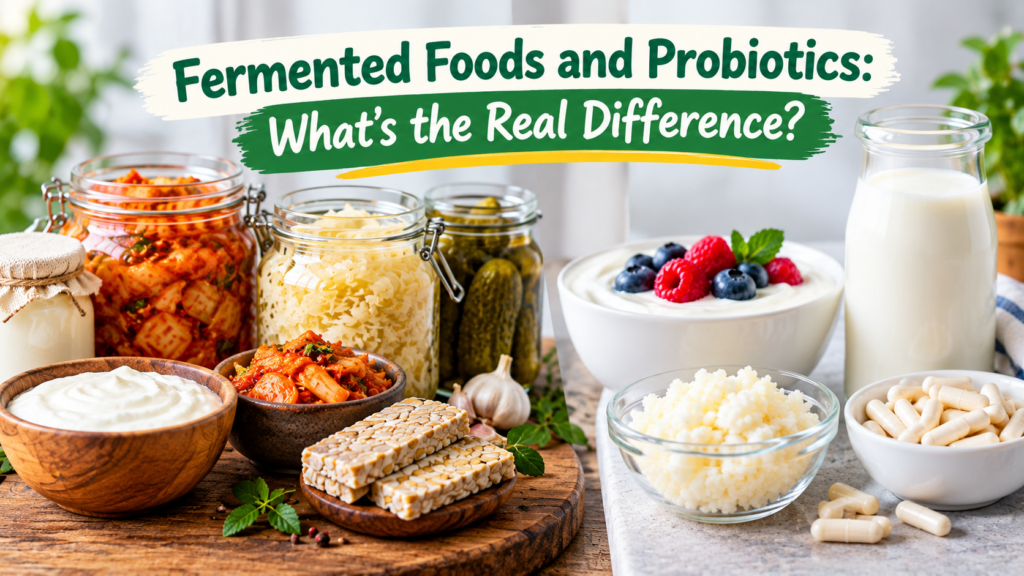
Fermented foods and probiotics are often used interchangeably, but they are not the same thing. One is a category of food; the other is a group of live microorganisms that must meet specific scientific criteria to earn the name. Understanding the distinction matters — especially if you’re choosing what to eat or buy to support your gut.
Table of Contents
ToggleThis guide breaks down the real difference, explains why kefir stands out among fermented foods, and shows how a prebiotic like wheatgrass fits into the picture.
What Are Fermented Foods?
Fermented foods are made through controlled microbial growth, where bacteria and yeasts convert sugars and starches into acids, gases, and alcohol. This process preserves food, enhances flavour, and can introduce beneficial compounds.
Common examples include:
-
Dairy ferments — kefir, yogurt, mursik, kule naoto
-
Cereal ferments — uji, sourdough
-
Vegetable ferments — sauerkraut, kimchi
-
Beverage ferments — kombucha, water kefir
Not every fermented food contains live microbes at the point of consumption. Pasteurisation, baking, and filtration can kill or remove them. Sourdough bread and most soy sauce, for example, are fermented but no longer contain live cultures.
The key point: “Fermented food” describes how a food is made — not whether it delivers live probiotics.
Among fermented dairy options, kefir stands out as a fermented food that reliably delivers live cultures — it is made with live kefir grain cultures that remain active when properly stored. We’ll explore exactly how kefir works as a fermented food and probiotic in its own section below. For a deeper look at kefir’s full range of benefits, see our complete guide to kefir benefits.
What Are Probiotics?
The International Scientific Association for Probiotics and Prebiotics (ISAPP) defines probiotics as live microorganisms that, when administered in adequate amounts, confer a health benefit on the host. This definition is widely accepted in the scientific community.
Crucially, not every live microbe qualifies as a probiotic. To meet the definition, a strain must:
Be alive when consumed
Be present in adequate numbers
Have documented health benefits in controlled studies
Understanding the relationship between probiotics and fermented foods is key to choosing the right gut health support. A fermented food may contain live bacteria, but unless those specific strains have been studied and shown to deliver health benefits at the dose provided, it is not technically a probiotic.